

Scientists have performed the world’s first stem cell therapy on unborn babies with spina bifida, and every child in the trial was born healthy.
The breakthrough could change how one of America’s most common birth defects is treated – with the successful trial scaling up.
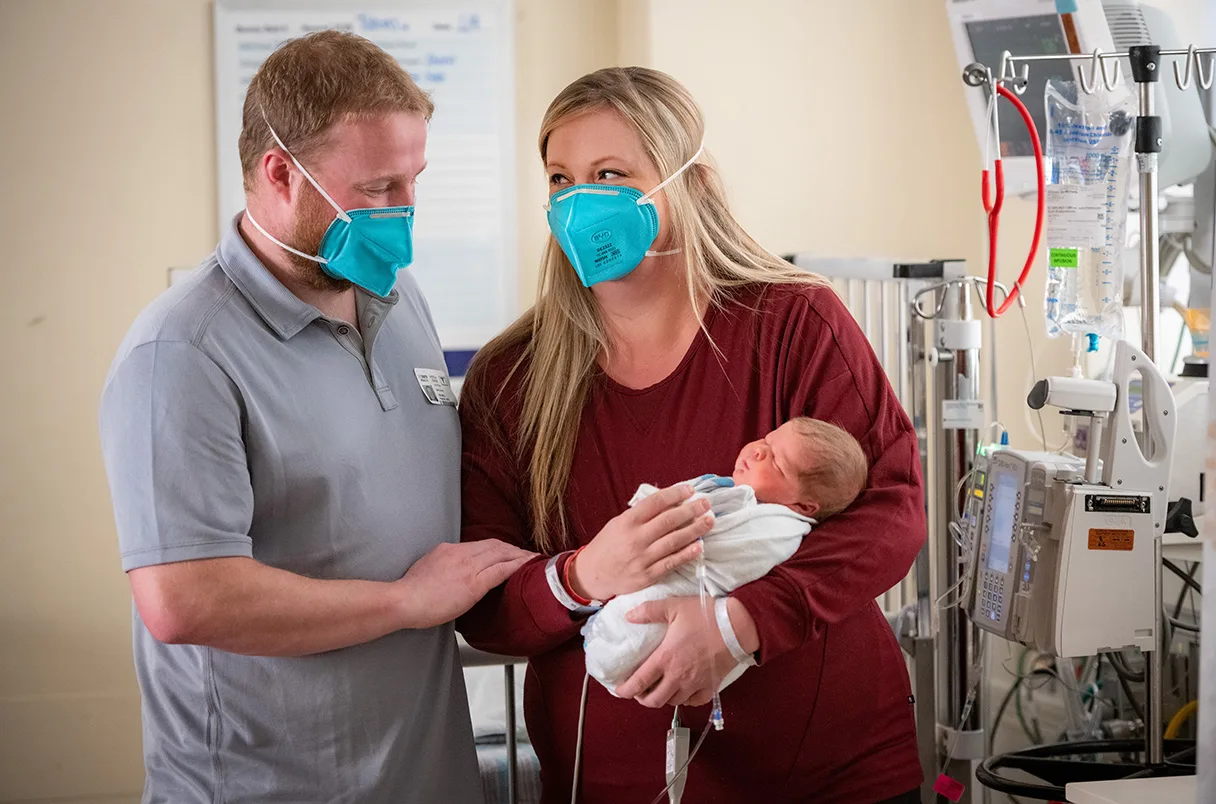
For one mom, Michelle Johnson and her partner Jeff Maginnis, the procedure has been life changing.
When she saw her 20-week ultrasound, her world shifted. Her unborn son Tobi had been diagnosed with severe spina bifida – a condition in which a baby’s spinal cord fails to form properly in the womb, leaving part of it exposed. She and Jeff raced to understand their options.
What they found was a trial unlike anything that had been attempted before.

Researchers at UC Davis Health were recruiting mothers for a study that would add something new to standard fetal surgery – a patch of live stem cells placed directly onto the baby’s exposed spinal cord, while still in the womb. Michelle signed up. Tobi became one of six babies to receive the treatment.
He was born with his spinal repair intact with no infection or complications. Even more incredibly, his MRI showed that a brain abnormality linked to spina bifida had reversed.
More widely, every single baby in the trial had the same result – something that could change stem cell therapy forever.
Results from the Phase 1 study – called the CuRe Trial – were published last month in The Lancet, marking a landmark moment in prenatal medicine.
Spina bifida affects between 1,500 and 2,000 children in the United States every year. The condition can cause lifelong paralysis, mobility problems, and bladder and bowel complications. Fetal surgery to close the wound has been the gold standard for over a decade – but it doesn’t prevent all neurological damage.
The UC Davis team wanted to go further. Their approach uses stem cells taken from donated placentas, applied to the exposed spinal cord during surgery. The cells are designed to reduce inflammation, promote healing, and protect the developing spine from further damage before birth.
Six mothers took part between 2021 and 2022. All six babies were born with their repairs intact, with no infections, no fluid leaks, no abnormal tissue growth, and no tumor formation.
“Putting stem cells into a growing fetus was a total unknown. We are excited to report great safety,” said Diana Farmer, the trial’s principal investigator and chair of the UC Davis Department of Surgery.
Her co-investigator, Aijun Wang, put the achievement in plain terms. “This is a major step toward a new kind of fetal therapy,” he said, “one that doesn’t just repair but potentially helps heal and protect the developing spinal cord.”
The first phase of the trial was funded by a $9 million grant from the California Institute for Regenerative Medicine. All six children will be monitored until they turn six, giving researchers long-term data on mobility and quality of life.
Those results have already been enough to earn approval for a second, larger trial – this time involving 29 participants – giving the team the statistical power to confirm whether the stem cells lead to measurably better outcomes for children.
Farmer was clear about what she believes comes next. “It paves the way for new treatment options for children with birth defects,” she said. “The future is exciting for cell and gene therapy before birth.”
Researchers say the approach could eventually extend to other conditions diagnosed in the womb – opening an entirely new chapter in the story of medicine before birth.
For Michelle Johnson, that future started the moment Tobi arrived safely into the world.